









Weight Is Determined by Habit, Age, and Sex — Why Diets Plateau and Why the Weight Comes Back
About this article. This is an educational article written by a physician. It is not medical advice for any individual, and it is not an invitation to consult. Fukumoto Clinic practices in Japanese only.
Part I derives, using nothing but arithmetic, why weight loss slows down and stops. Part II places that derivation against the international literature and states plainly where it is wrong. Part III is what I actually ask patients to do.
Two sentences, more than any others, are said to me in the consulting room.
“I kept restricting my food, and then the weight just stopped coming off.”
“I stopped dieting, and it all came straight back.”
In almost every case, neither sentence is a confession of weakness. Both describe something that body weight simply does. Weight has this property built into it, and you can see exactly why with arithmetic you already know.
Here is the conclusion, before the derivation:
where K is the basal metabolic rate per kilogram of body weight
The numerator is your habits. The denominator is a constant fixed by your age and sex. So:
Your weight is determined by your habits, your age, and your sex.
Put differently: a person who weighs 100 kg is living the habits that hold a body at 100 kg. Change the habits and the weight changes. Return to the old habits and the weight returns. That single sentence is the starting point of everything I do in weight management.
Part I — The derivation
1. Three equations nobody disputes
② Calories burned = Calories burned in activity + Basal metabolic rate
③ Basal metabolic rate = K × Body weight
Basal metabolic rate (BMR) is the energy your body spends simply growing and maintaining itself — skin, fat, muscle, bone, and the internal organs. The bigger the frame and the organs, the larger the BMR.
Plants make this intuitive. A plant spends energy growing and maintaining its leaves, stem, roots and fruit, but it does not move. A plant’s “calories burned in activity” is zero, so all of its expenditure is basal. Human BMR is the same thing: the energy required to build and maintain the body itself.
K is BMR per kilogram of body weight (kcal per kg per day). Japan’s Ministry of Health, Labour and Welfare publishes it by age and sex in the Dietary Reference Intakes for Japanese (2025):
| Age | Men | Women |
|---|---|---|
| 18–29 | 23.7 | 22.1 |
| 30–49 | 22.5 | 21.9 |
| 50–64 | 21.8 | 20.7 |
| 65–74 | 21.6 | 20.7 |
| 75+ | 21.5 | 20.7 |
A note for readers outside Japan. These are Japanese national reference values, derived from a Japanese population. Your own country’s authority will publish its own figures, and predictive equations such as Schofield or Henry are used elsewhere. The exact number of K is not what matters here. What matters is that K is a constant you cannot change by trying harder — and every step of the argument below holds whatever value you put in.
Two things about K decide everything that follows. It is fixed by age and sex — no effort of yours moves it. And it falls with age. Hold on to that second point; it returns later with some force.
2. Folding the three into one
Substitute ② and ③ into ①:
There is a problem. The left side is in kilograms; the right side is in kilocalories. They cannot be equal as written. We need a conversion, and the conventional one is 1 g of body fat = 7 kcal, so 1 kg = 7,000 kcal. Written per day:
This is the central equation. Everything else falls out of it.
3. Why the loss keeps slowing down
Take someone who has just adopted a new set of habits. Assume calories eaten and calories burned in activity are now constant under those new habits — this is the whole point of a habit.
Month 1: 70 kg → 66 kg (4 kg lost). Write the equation over 30 days, using the average weight for the month (68 kg) to compute the basal term. Writing I for daily intake and A for daily activity calories:
Month 2: starting from 66 kg, suppose ΔW kg are lost. Same habits, so the average weight this month is 66 − ΔW/2:
Now subtract (B) from (A). Because the habits did not change, I and A cancel completely. Only the basal terms survive:
Solve for ΔW:
Now take the number 4 — last month’s loss — and rewrite it over the same denominator. Multiplying numerator and denominator by the same quantity changes nothing, so this is still just 4:
Put them side by side. Same denominator. The numerators differ by exactly 120K:
4 = (28,000 + 60K) ÷ (7,000 + 15K)ΔW = 4 − 120K ÷ (7,000 + 15K) < 4 kg
Keep the exact habits that took 4 kg off in month 1, and month 2 will take off less than 4 kg. Always. The arithmetic leaves no room.
The reason is plain once you see it. Weight went down, so the basal metabolic rate — which is K × weight — went down with it. Same food, same exercise, but the body now burns less. The deficit shrinks by itself.
Repeat the identical calculation for month 3, month 4, and so on:
Each month’s loss is smaller than the last, and never turns negative. ΔW converges to zero. The weight does not keep falling. It stops.
4. Where, exactly, does it stop?
Go back to the central equation and substitute the condition “weight has stopped changing” — that is, change in weight = 0:
Solve for weight:
Which is where we came in.
Notice what vanished: the 7,000. That conversion factor governs only how fast you converge. It has no influence whatsoever on where you converge. This is worth sitting with, because it means every argument about the exact energy density of fat tissue — and there are many — is an argument about the speed, not the destination.
The numerator is intake and activity: habits. The denominator is a constant set by age and sex. The claim is proved.
How fast? Years, not weeks. Treat the central equation as a differential equation and the weight approaches its target exponentially, with a time constant of roughly 7,000 ÷ (K × physical activity level) days. For a man aged 30–49 at a “moderate” activity level (1.75), that is about 180 days — a half-life of roughly four months.
So a new set of habits takes more than a year to finish paying out. “It stopped after three months” does not mean you failed. It means you are not finished.
5. A worked example: cut 100 kcal a day
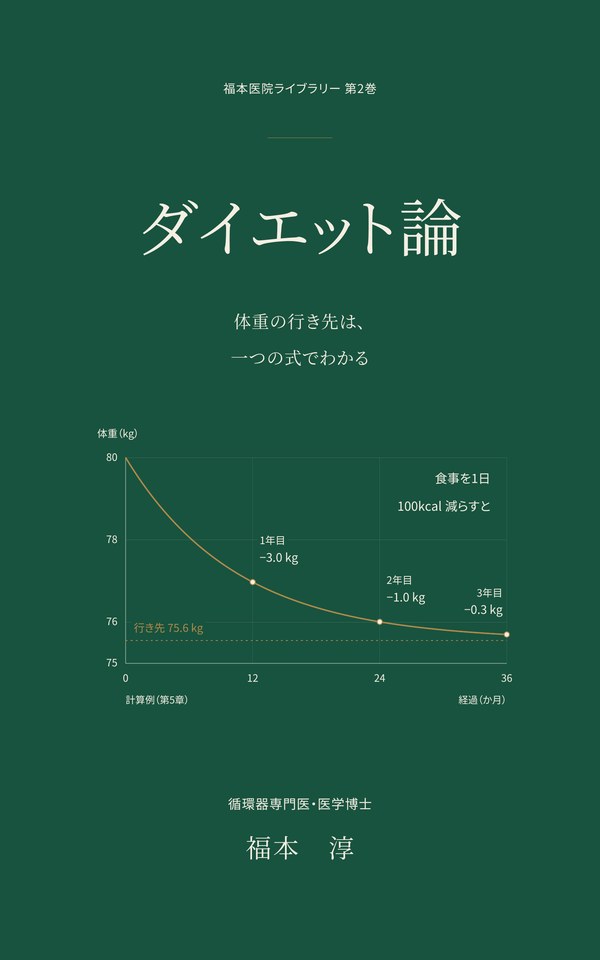
Halve the rice at dinner. Call it 100 kcal a day. Keep it up. What happens?
The naive prediction. 100 kcal × 365 days = 36,500 kcal. At 7,000 kcal per kg, that is 5.21 kg in the first year — and, presumably, another 5.21 kg the year after.
What actually happens. Nothing of the sort. As weight falls, BMR falls with it, and the whole thing converges. From the conclusion:
For a man aged 30–49 (Japanese reference weight 70.0 kg, K = 22.5, activity level 1.75), the honest answer is about −2.5 kg.
Roughly −2.2 kg by the end of the first year. And then, no matter how long you keep going, it never goes past −2.5 kg.
Why is it smaller than 100 ÷ K? Strictly, the calories you burn in activity are also proportional to body weight — hauling a heavier body around costs more. Fold that in and the effective denominator becomes K × physical activity level, which is larger, so the total change is smaller. The figure above reflects that.
What cutting 100 kcal a day buys you is not “5 kg a year.” It is “a body 2.5 kg lighter, for the rest of your life.”
That is not a failure. It means a new weight has been defined by a new habit. Which is the entire point.
6. What the equation says about plateaus and rebound
Why am I not losing weight?

Because — the equation is blunt about this — your current habits match your current weight. The change has not gone far enough. You are still eating too much, or moving too little, or both.
But note carefully: the slowing itself is normal. A plateau is not failure. It is arrival — at the weight your habits specify. If you want to go lower, you must change the habits again. Not try harder at the same ones.
What rebound actually is
If habits determine weight, then the contrapositive is immediate: go back to the old habits and the weight goes back too.
That is rebound. Not weak will. Not a broken metabolism. Not a bad constitution. The equation simply reverted.
And here is the uncomfortable corollary. Reaching your goal weight and then “stopping the diet” is returning to the old habits. So the weight must come back. There is no version of this where it does not.
Where diets and drugs fit
There are effective weight-loss methods, and there are effective weight-loss drugs. In this framework, starting one of them is exactly one thing: adopting a new habit.
Which means there are precisely two ways to avoid rebound:
- Continue the method or the treatment, indefinitely.
- Stop only once you already have habits that hold the goal weight.
Someone going from 70 kg to 50 kg introduces a method capable of −20 kg, and in parallel rebuilds their habits, and stops only when habits that sustain 50 kg are genuinely in place. That is the only path. Everything else is a loan that gets called in.
Weight-loss treatment is not the destination. It is the runway.
Getting older on the same habits makes you heavier
Look at the table again. K falls with age. In the conclusion, a smaller denominator with the same numerator means a larger converged weight.
So it is not “I gained weight even though I eat the same as I always did.”
It is “I gained weight because I eat the same as I always did.”
7. The “speed up your metabolism” myth
Look once more at equation ③:
K is a constant set by age and sex. Therefore the only way to raise your BMR is to get heavier. And correspondingly, when a diet works and your weight falls, your BMR falls. It has to.
“Raise your metabolism to lose weight” does not survive contact with this equation.
So why does muscle still matter enormously?
Because you should not be thinking about weight. You should be thinking about volume.
One gram of fat occupies about 1.10 cm³. One gram of muscle occupies about 0.91 cm³. Replace 10 kg of fat with 10 kg of muscle and the scale does not move by a single kilogram — while the body visibly tightens, by roughly 17% in volume.
The real goal of weight loss was never the number on the scale. It is less fat and less volume. Which makes building muscle — or at minimum, not losing it — decisive. That requires protein at or above the recommended intake, and resistance training built into ordinary life. Both are in Part III.
Part II — Where this sits in the literature, and where it is wrong
Everything above is arithmetic a schoolchild can check. That is its whole value. But arithmetic that nobody has checked against the literature is just confident arithmetic, so here is the check.
Hall et al. reached the same conclusion — with calculus
In 2011, Kevin Hall and colleagues at the US National Institutes of Health published a dynamic mathematical model of adult human metabolism in The Lancet 2). Their targets and their findings map almost exactly onto Part I.
They demolish the static rule — the “3,500 kcal per pound” rule, which says that a fixed daily deficit produces a steady, unending, linear weight loss. That rule had been written into official guidance by the NHS in the UK, the NIH and the American Dietetic Association in the US. It was derived by estimating the energy content of the tissue lost, and it ignores the fact that expenditure falls as the body shrinks — which is precisely the mechanism of Section 3 above.
What Hall’s model shows instead:
- Weight converges to a new steady state. Not endless linear loss — a plateau. (Sections 3 and 4.)
- A rule of thumb: for an average overweight adult, a permanent change of intake of 100 kJ per day (about 24 kcal) produces an eventual weight change of about 1 kg.
- It is slow. About half the total change arrives in the first year; about 95% takes around three years.
The last point deserves emphasis, because it is the one that rescues people. A 100 kg sedentary man who cuts 500 kcal a day settles at around 75 kg — but takes years to get there. The static rule predicts he loses 22 kg in the first year alone, and the resulting error can reach about 10 kg within that year. That gap between promise and reality is where most people conclude they have failed, and quit.
So: the arithmetic of Part I and the calculus of Hall agree on the shape of the answer. Weight converges, and it converges slowly. Nothing in Part I is original. It is a route to a known destination that a patient can walk unaided — which is the only thing I claim for it.
Where my equation is wrong
The numbers do not agree, and I would rather say so than have you find out.
| The equation above | Hall et al. | |
|---|---|---|
| Cut 100 kcal/day → eventual loss | −2.5 kg | about −4 kg |
| Cut 500 kcal/day → eventual loss | −12.7 kg | about −25 kg (100 kg adult) |
| Half-life of the change | about 4 months | about 1 year |
My equation under-predicts how much you can lose, and over-predicts how fast. Both errors have a single source, and it is worth naming precisely.
K is an average, and I used it as a marginal
K = 22.5 kcal/kg/day is a whole-body average: total basal expenditure divided by total body weight. But the tissues that make up that average are wildly unequal. Elia’s classic figures 3), in kcal per kg per day:
| Tissue | kcal/kg/day |
|---|---|
| Heart, kidneys | 440 |
| Brain | 240 |
| Liver | 200 |
| Skeletal muscle | 13 |
| Adipose tissue | 4.5 |
| Everything else | 12 |
Now ask the question that actually matters: when you lose one kilogram, which kilogram is it?
Overwhelmingly, adipose tissue — at 4.5 — plus some skeletal muscle, at 13. Your heart, kidneys, brain and liver do not shrink. They are carrying the enormous coefficients, and they are not the tissue leaving.
So the metabolic cost of the marginal kilogram is far below the 22.5 average. My equation divides by a denominator that is too big. Therefore it predicts too little weight change. The direction of the error is not in doubt; only the size of it is, and for that you should use Hall’s empirical answer — about 24 kcal/kg/day for the average overweight adult, not my 39.
Which means: the fatter you are, the more wrong I am
The gap between the average and the marginal widens with adiposity. Hall’s finding is explicit: adults with more body fat lose more weight for the same intake change, and take longer to get there. Independent work confirms that Elia’s coefficients hold up in non-obese adults but require adjustment in the obese 4).
So, honestly:
- Near a standard build, the equation works well. Its answer for a 100 kcal cut — about 2.5 kg — sits close to the figure published in Japan’s own dietary guidelines, which put the plateau at roughly 2 kg.
- In severe obesity, do not use it. For a 100 kg adult cutting 500 kcal a day it says −13 kg where Hall’s simulation says −25 kg. It will badly undersell what is achievable, and that is the last thing anyone in that position needs to hear.
One caution in the other direction, for completeness. Hall’s simulations assume the intake cut is actually sustained. In reality it rarely is: weight loss drives a compensatory rise in appetite of roughly 100 kcal per day for every kilogram lost 5). Real-world results therefore tend to land below the model’s ceiling — not because the person is weak, but because the biology is pulling in the other direction the whole way down.
What survives
Every number above can move. The structure cannot:
- Weight converges. It does not fall forever.
- The destination is set by habits, age and sex.
- A plateau is not failure.
- Rebound is the equation reverting, not a character flaw.
Whatever value you put in the denominator, convergence is preserved. That is the part I would defend anywhere.
Part III — What to actually do
If you weigh 70 kg and want to weigh 50 kg, there is exactly one task: acquire the habits of a person who weighs 50 kg. Here is what I ask patients to do.
1. Make it a hobby
The moment it becomes a penance or a quota, it is over — and a thing you do not continue is not, by definition, a habit. This is not motivational fluff; it is a technical requirement. Part I showed that reaching the new weight takes years. A method you cannot sustain for years is not a method. Treat the falling number as the day’s small pleasure. Picture, concretely, the version of you at the other end.
2. Weigh yourself daily — and read the trend, not the day
Step on the scale after your bath, every day, and record it. Look at the graph, not the number.
Weight behaves like a stock price. A 0.5 kg jump overnight is completely ordinary and is almost entirely water. Judging yourself on a single day’s reading is judging yourself on noise.
Get a scale that records automatically. Manual entry fails, far faster than anyone expects. A smartphone-linked scale logs the moment you stand on it. This single choice has an outsized effect on whether you are still doing this in six months — treat it as the investment that turns the habit into “just stand there.”
3. Movement — build it into the life you already have
What the guidelines say. Japan’s national physical activity guide (2023) recommends, for adults: 60+ minutes daily of walking or equivalent — about 8,000+ steps; resistance training 2–3 days a week; and avoid long unbroken sitting. For older adults, about 6,000 steps.
What I actually say. Nobody goes from a standing start to 8,000 steps and stays there. So: put the floor at 5,000 steps, hold it, then walk it up toward 8,000. A target you abandon never becomes a habit, and a habit is the only thing that moves the numerator.
Do the resistance training. Section 7 explained why: the goal is volume, not the scale. Lose muscle and the weight falls while the body stays soft.
Do not try to find time to exercise. Carving out a new hour is how people quit in week three. Convert what you already do:
- On a fine morning, get up an hour early and walk for 30 minutes.
- Swap the car commute for the train.
- On the way home, walk one, two, three stops — and get on the train when you have had enough.
- Take the stairs as far as you can, then take the lift the rest of the way.
Deciding in advance that you are allowed to stop partway is what makes it survive. (Cycling on flat ground, incidentally, is excellent transport and mediocre exercise. Do not count on it.)
4. Meal timing — leave a gap
This is the highest-yield item on the list.
Body fat is only mobilised for energy once the supply of glucose runs out. Put the other way round: while you keep eating, your fat is never called upon. Hence the gap between meals matters.
What I suggest is a gap of 15 hours or more, once a day:
Finish dinner by 21:00 → skip breakfast → eat lunch after 12:00 the next day. (21:00 to 12:00 is 15 hours.)
Skipping breakfast may feel wrong. But “three proper meals a day” is not automatically optimal for someone trying to lose weight. During a weight-loss phase, securing a genuine gap is the more coherent strategy.
Please read this before trying it. This approach is not for everyone. If any of the following applies to you, do not do this on your own judgement — speak to your own doctor first. Hypoglycaemia is a real danger.
- Anyone being treated for diabetes — particularly on insulin or sulfonylureas
- Anyone on any medication that can cause hypoglycaemia
- Anyone pregnant or breastfeeding
- Older adults, underweight people, anyone whose physical reserves are low
- Anyone with a history of an eating disorder
- Children and adolescents
“Hungrier is better” is false. A genuine gap helps. Extreme fasting is counterproductive. Run short of both energy and protein for long enough and the body will break down muscle to make up the difference — at which point your volume does not fall, and the mirror does not change. Hunger that brings dizziness, loss of concentration, or feeling unwell has gone too far. That is a signal, not a score.
5. Nutrition — cut carbohydrate, protect protein
Carbohydrate. Until you reach your goal weight, keep it low. Rice, bread, noodles — and sugared drinks, which are the easiest large win most people have available.
Protein is not negotiable. This is the one line you do not cut. Japan’s 2025 dietary reference intakes recommend:
| Age | Men | Women |
|---|---|---|
| 18–49 | 65 | 50 |
| 50–64 | 65 | 50 |
| 65+ | 60 | 50 |
While losing weight, do not go below this. Diet without enough protein and the body takes the deficit out of muscle rather than fat — which defeats the entire purpose.
| Food | Portion | Protein |
|---|---|---|
| Chicken breast, skinless | 100 g | ~23 g |
| Beef or pork, lean | 100 g | ~20 g |
| Fish (salmon, mackerel) | 1 fillet (80 g) | ~18 g |
| Firm tofu | 150 g | ~10 g |
| Natto | 1 pack (50 g) | ~8 g |
| Egg | 1 | ~6 g |
| Milk | 200 ml | ~7 g |
A chicken breast, a fillet of fish, two eggs and a pack of natto comes to roughly 62 g. Add tofu or milk and a man clears the recommendation.
Water. Eat less and you also drink less, because a surprising share of your fluid comes from food. Drink calorie-free fluids deliberately.
Vitamins. Eat less and you get fewer vitamins. A multivitamin covers the gap cheaply.
6. When you are going to eat anyway
Not a moral failure — a choice to be made well.
- Choose the protein-heavy option — grilled meat, yakitori, fish, eggs.
- If it must be a rice bowl — small rice, extra meat on the side, an egg on top.
- If it must be ramen — leave as much of the noodle as you can, and load it with pork and egg.
The principle never changes: take out carbohydrate, put in protein.
7. An occasional large meal is genuinely fine
This follows directly from Part I, and it matters more than it looks.
Weight is determined by habits. Turn that over: a one-off act, which is not a habit, does not determine your weight.
Suppose one day you eat 2,100 kcal more than you should. At 7 kcal per gram of fat, that is 300 g. And as long as it does not become a habit, the weight drifts back to whatever your habits specify.
A single big meal does not erase months of work. The thing to watch is never the day. It is the habit.
8. If you drink
Choose distilled spirits — a highball is the easy default. Beer, sake and sweet cocktails carry substantially more sugar.
One caveat, and it is the one people dodge: a low number on the label means nothing if the volume goes up. “It’s zero-sugar” is not a licence for a fourth one.
Separately from weight, alcohol affects blood pressure, cardiac arrhythmia and the liver. If you can drink less, drink less.
9. Think back to when you were thinner
The thinner version of you was, almost certainly, someone who:
- spent far more hours of the day hungry,
- had less money in their wallet,
- and went to the convenience store far less often.
Weight is set by habits — so recover those habits and you recover that weight. Concretely: keep carbohydrate out of arm’s reach and stop snacking; do not carry much cash; stay out of the convenience store.
The point is not to summon more willpower. It is to reduce the number of moments in which your willpower is tested. That is the whole trick, and it is why it works.
10. Ageing on the same habits makes you heavier
K falls with age. Smaller denominator, same numerator, larger converged weight. So unless you eat progressively less as you age, you will gain — with certainty. Not “despite eating as I always did.” Because of it.
11. When the weight will not move
The equation is unsentimental: the change in habits is not yet sufficient. Still eating too much, still moving too little, or both.
But — again — the slowing is normal. Weight converges; it does not fall forever. A plateau means you have approached the weight your habits define. To go lower, change the habits another notch.
One exception worth knowing. Rapid or unexplained weight change, in either direction, can indicate an underlying condition — thyroid dysfunction among others. If the numbers do not match the behaviour, that is worth investigating with a doctor rather than pushing harder.
12. If changing how you eat is genuinely beyond you right now
Some people read all of the above and know, honestly, that they cannot execute it. That is a legitimate position, and medicine has something to offer.
GLP-1 receptor agonists are now well established for weight management in people with obesity. They are prescription medicines with real side effects, real costs, and real variation in response between individuals — they require a doctor, and they require assessment of whether they are appropriate for you. What I can offer here is not a recommendation but a framing, and it is the same framing as everything else in this article:
Starting a drug is adopting a new habit. Nothing more mysterious than that. Which means Part I’s conclusion applies without modification: stop the drug, return to the old habits, and the weight returns. The equation does not care why the numerator changed.
So the treatment is worth doing when it is used as it should be: alongside a rebuild of the habits, with the goal of stopping only once habits that hold the target weight are actually in place.
The drug is not the destination. It is the runway.
13. Rebound, one last time
“Weight is determined by habits, age and sex” means, with no wriggle room, “return to the old habits and the weight returns.”
That is all rebound has ever been. Not willpower. Not your constitution. The equation reverted.
So: acquire habits that hold the goal weight, and only then finish the diet.
The goal of a diet was never reaching the target weight. It is owning the habits that keep you there.
Summary
- Weight is determined by habits, age and sex
- Hold the same habits and weight does not fall forever — it converges to one point
- The destination is (intake − activity) ÷ K, and the 7,000 kcal conversion has no effect on where you land
- Convergence takes years. A plateau is not failure
- Go back to the old habits and the weight goes back. That is rebound
- You cannot raise your BMR — but keeping muscle determines your body’s volume
- K falls with age. The same life makes you heavier
- This arithmetic under-predicts loss and over-predicts speed, increasingly so with obesity. For accurate individual projections, use Hall’s model 2) or the NIH Body Weight Planner
If your weight is not what you want it to be, the thing to change is not the weight. It is the habits. Live as the person at your goal weight lives. Stripped to its core, dieting is nothing but that.
Limits of this article
- It does not apply to severe obesity or severe underweight. The reference values used are drawn from populations of standard build. See Part II.
- Basal metabolic rate varies between individuals. This is an approximation built on population averages, and guarantees nothing about any one person.
- Conditions affecting metabolism change the premises — thyroid disease among them. Rapid weight change should prompt investigation, not effort.
- Short-term weight swings are largely water and glycogen, and cannot be read as changes in fat.
- 1 g of body fat = 7 kcal is an approximation. Adipose tissue contains water and other components.
Fukumoto Clinic practices in Japanese only, in Osaka, Japan. This article is educational and is not an invitation to consult, nor a substitute for individual medical advice. If you are being treated for any condition — diabetes in particular — discuss any change to your eating with your own physician before making it.
Author
Atsushi Fukumoto, MD, PhD — Director, Fukumoto Clinic
Internal Medicine and Cardiology
Kobe University School of Medicine, 1997
PhD in Medicine
Board-Certified Cardiologist (Japanese Circulation Society, reg. no. 15490)
Full profile
References
- Ministry of Health, Labour and Welfare, Japan. Dietary Reference Intakes for Japanese (2025). Published October 2024.
https://www.mhlw.go.jp/stf/newpage_44138.html - Hall KD, Sacks G, Chandramohan D, Chow CC, Wang YC, Gortmaker SL, Swinburn BA. Quantification of the effect of energy imbalance on bodyweight. Lancet. 2011;378(9793):826-837.
https://pubmed.ncbi.nlm.nih.gov/21872751/ - Elia M. Organ and tissue contribution to metabolic rate. In: Kinney JM, Tucker HN, eds. Energy Metabolism: Tissue Determinants and Cellular Corollaries. New York: Raven Press; 1992:61-79.
- Wang Z, Ying Z, Bosy-Westphal A, et al. Evaluation of specific metabolic rates of major organs and tissues: comparison between nonobese and obese women. Obesity. 2012;20(1):95-100.
https://pubmed.ncbi.nlm.nih.gov/21836642/ - Polidori D, Sanghvi A, Seeley RJ, Hall KD. How strongly does appetite counter weight loss? Quantification of the feedback control of human energy intake. Obesity. 2016;24(11):2289-2295.
https://pubmed.ncbi.nlm.nih.gov/27804272/ - Ministry of Health, Labour and Welfare, Japan. Physical Activity and Exercise Guide for Health Promotion 2023.
First published (video): 13 July 2021. This English edition: July 2026.
福本医院は大阪市中央区南船場にある内科・循環器内科です。
大阪メトロ御堂筋線・心斎橋駅から徒歩2分、なんば(難波)からは1駅です。長堀橋・本町・四ツ橋からも徒歩圏内で、新町・堀江・立売堀をはじめ大阪市西区からも多くの患者様にご来院いただいております。